
You walk in, and the whiteboard is covered in words and numbers. AMRAP. 21-15-9. Rx. Something about “skill work.” Everyone else seems to know exactly what’s going on.
Time out. Every single person in that room started exactly where you are – having never done CrossFit before and not totally understanding the whiteboard (maybe even questioning if they can do the stuff written on the whiteboard).
Here’s the most important thing to know about your first few weeks of classes: we’ll coach you for the entire hour. Your job is to show up, listen, and work. Ours is to handle the rest.
What’s the Flow of a Class?
Every class at Roots follows the same structure. Our coaches write a daily lesson, so whether you come at 6:30 a.m. or 5:00 p.m., you’ll get the same experience and flow.
Here’s the outline of every class:
- The whiteboard. We start every workout at the board. The coach will cover the day’s workout, what it’s meant to feel like (we call that the stimulus), and various ways you can scale the workout if you don’t yet have a specific skill or capacity.
- General warm-up. This is where we’ll elevate your heart rate, take your joints through a full range of motion, and practice basic movement literacy.
- Specific warm-up. This is where we practice and refine the movements you’ll do in the day’s workout as well as settle on scaling options. This is where athletes are made, in the focused practice of basic skills.
- The workout. “3-2-1-Go!”
- Cool-down, scores, and skill work. We’ll collect scores at the whiteboard. At Roots, everyone gives their scores. It’s part of what keeps us honest, connected, and working toward a training goal. We even still write them by hand. You’ll get used to the cadence of how to deliver your score.
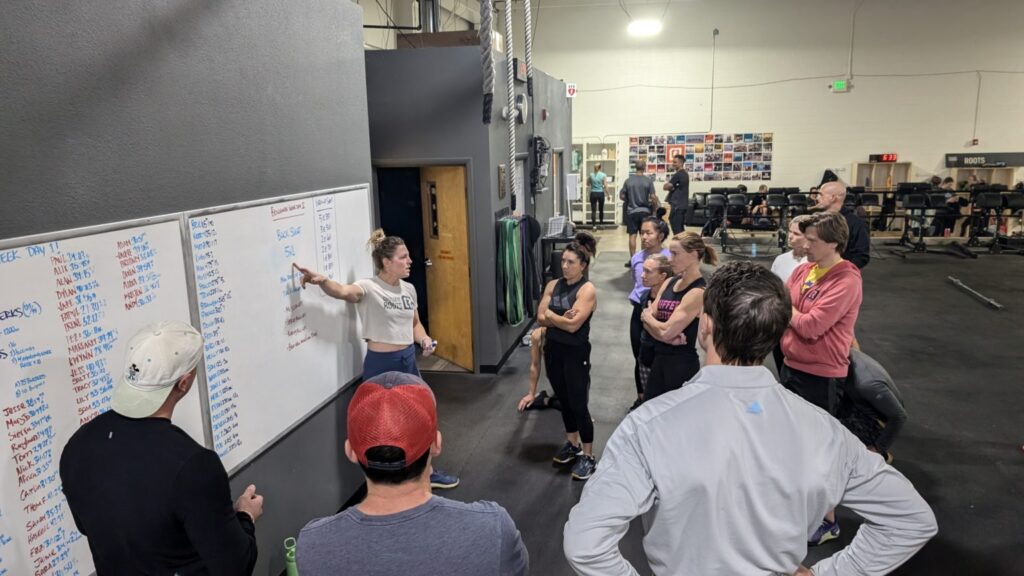
Reading the Whiteboard
A few terms you’ll see often:
| Term | What it means |
|---|---|
| For time | Do the work as fast as you can. Your score is your time. |
| AMRAP | As many rounds (or reps) as possible in a set amount of time. Your score is rounds + reps. |
| Rx | “As prescribed.” The workout exactly as written. Every part of it. |
| Scaled | The workout adjusted to address limits in skill or capacity while also providing a pathway to development. |
Reporting Your Score at the Whiteboard
At first glance, it’s sometimes intimidating to tell the world, ok, just the class, what your score was. But it’s a huge part of who we are and how our coaches work with athletes.
It’s less about who won and more a statement of this is what I had to give for the day.
Your score tells you where you are, so you can see your progress over time and stay accountable to loading, reps, and movements. And it tells your coach how it went. The whiteboard is one of the most important coaching tools at the shop.
After class, log it in SugarWOD too, so you have a record of every workout you’ve done and so you can participate in the “after party” of each daily workout. SugarWOD is where athletes can celebrate their wins and fist bump other athletes. We’ll talk about SugarWOD at a later date. But, if you want to download it now, head over to the app store, download SugarWOD, and log in with the same credentials you use for ZenPlanner.
Rx, Scaling, and Training
Every workout has an intended stimulus: how it’s supposed to feel and how long it’s supposed to take. Scaling means adjusting the load, the reps, or the movement so you get that same stimulus, safely, with the appropriate challenge for today.
Scaling isn’t a lesser version of the workout. It’s how you build the strength and skills to get there. At Roots, scaling is the pathway to progress for any athlete and is seen as the respected approach by both athlete and coach.
And please, don’t skip class because of what’s on the board. If you can’t do handstand push-ups yet, that’s exactly why you should come. We’ll have an option ready, and we’ll coach you through it. And training our weaknesses is a near and dear concept to us at CrossFit, more on that later.
Your One Thing This Week
Listen to everyone reporting their scores at the whiteboard. Listen to how they do it quickly, and use the scaling options to specify how they scaled the workout. Try to mimic that when you give your score.
Want to Learn More?
Read this article written by Nicole Christensen – Why Every Class at CrossFit Roots Starts and Ends at the Whiteboard